01 · Modernization Has Always Been About Improvement
Enterprise modernization has taken many forms over the past several decades. Organizations have modernized infrastructure, applications, development practices, integration architectures, and operating models. More recently, modernization initiatives have focused on hybrid cloud, application transformation, automation, and the adoption of artificial intelligence across the enterprise.
These investments have helped organizations become more agile, resilient, efficient, and responsive to changing business demands. Yet every enterprise transaction contains another asset that is rarely considered a modernization target: the decision itself.
Every payment, claim, customer interaction, order, account update, and service request traverses a series of decisions. Transactions are approved or declined. Claims are paid or referred. Customers are prioritized, routed, escalated, or retained. Risks are assessed. Exceptions are identified. Actions are triggered.
These decisions are not new. They already exist within the transaction flows of systems that have operated reliably for years, and in many cases decades. What has changed is the amount of contextual information available at the moment those decisions are made.
As organizations digitize operations, expand channels, connect ecosystems, and generate increasing volumes of data, the opportunity emerges to improve the quality of transactional decisions through broader contextual awareness. This is the objective of AI-enabled decision modernization.
Decision modernization does not replace transaction systems. It does not replace deterministic controls. It does not transfer ownership of decisions to autonomous systems. Instead, it enhances existing transactional decisions by incorporating additional context that was previously difficult or impractical to evaluate within the transaction itself.
Advances in artificial intelligence and machine learning now make it possible to incorporate contextual intelligence directly within enterprise transaction environments. Organizations can evaluate behavioural patterns, temporal relationships, activity velocity, workflow progression, network relationships, operational state, and environmental context at the moment a transaction occurs. This allows existing decision frameworks to become more contextually aware while preserving established governance, controls, and operational ownership.
The challenge is not identifying where AI can be deployed. The challenge is identifying which transactional decisions would benefit from additional contextual awareness.
This article introduces seven decision modernization patterns that provide a practical framework for understanding how AI can enhance existing transactional decisions while preserving the integrity, governance, and operational control that enterprise transaction processing requires.
02 · Why Transactional Decisions Need Modernization
Deterministic decisioning remains the foundation of enterprise transaction processing. Whether implemented through application logic, business rules, decision tables, workflow controls, operational policies, or purpose-built decision management systems, deterministic decisions provide the consistency, predictability, auditability, and regulatory control required by enterprise systems.
These characteristics remain essential. Enterprise transaction processing depends upon them.
The challenge is not that deterministic decisioning is flawed. The challenge is that the environment surrounding those decisions has evolved significantly.
Customers interact across multiple channels. Transaction volumes continue to increase. Digital ecosystems create new relationships between organizations, partners, and customers. Fraud techniques evolve continuously. Business processes generate far more contextual information than was available when many decision frameworks were originally designed.
As complexity increases, organizations typically respond by introducing additional rules, thresholds, decision branches, exceptions, routing conditions, and policy controls. A decision that begins as a straightforward business rule gradually accumulates special cases, conditional logic, and operational overrides. Over time, the decision framework becomes increasingly difficult to understand, maintain, and optimize.
This is not a failure of deterministic decisioning. Deterministic controls remain essential for governance, compliance, explainability, and operational consistency. The challenge is that increasingly contextual decisions require awareness of information that static decision frameworks struggle to incorporate efficiently.
Consider a transaction authorization decision. Following a loss event, a threshold is adjusted. Customer complaints follow, leading to exceptions for specific customer segments. Additional rules are introduced for different channels, geographies, or transaction types. Time-of-day conditions are added. Within a relatively short period, what began as a straightforward decision evolves into a complex collection of rules, exceptions, and conditions that few people fully understand and even fewer are willing to modify.
The underlying issue is not the number of rules. The issue is that static decision frameworks can only evaluate the contextual dimensions explicitly encoded within them. Behavioural patterns, temporal relationships, activity velocity, workflow progression, network relationships, operational state, and environmental context often remain outside the decision itself.
AI-enabled decision modernization addresses this challenge by extending the contextual awareness available to existing transaction systems.
Deterministic controls remain authoritative. Existing applications retain ownership of workflow execution, transaction integrity, resiliency, governance, and final decision authority. AI serves as a contextual enrichment capability that improves the quality of information available at the moment of decision.
The objective is not autonomous decision-making. The objective is better-informed decision-making.
The following patterns describe the primary ways in which transactional decisions can be modernized through contextual awareness.
03 · Seven Decision Modernization Patterns
The patterns described in this artcile are not industry solutions, reference architectures, or predefined use cases. They represent recurring ways in which transactional decisions can be modernized through contextual awareness.
Every organization already possesses thousands of transactional decisions embedded within business processes. The challenge is determining which decisions would benefit from additional context and what type of context would improve decision quality. Some decisions benefit from understanding behavioural history. Others depend on timing, activity concentration, workflow progression, operational state, or relationships between entities. Different decisions require different forms of contextual awareness.
The seven patterns that follow provide a practical vocabulary for identifying and categorizing decision modernization opportunities across industries, business functions, and transaction types. Rather than starting with technology, models, or platforms, organizations can begin by examining the decisions already being made and asking where additional context could improve outcomes.
A useful way to think about decision modernization is to ask a simple question:
Which decisions would improve if they had access to more context at the moment they occur?
The answer often reveals opportunities that already exist within current transaction flows, allowing organizations to modernize decisions without replacing the systems that execute them.
The patterns should not be viewed as mutually exclusive. Many high-value transactional decisions combine multiple forms of contextual awareness simultaneously. A fraud decision, for example, may incorporate behavioural, temporal, velocity, relationship, and location awareness. A healthcare claims decision may combine behavioural, sequence, state, and temporal awareness. The patterns provide a framework for understanding how context contributes to decision quality rather than a prescriptive architecture for implementation.
Each pattern addresses a different limitation of traditional decision frameworks. Some focus on understanding historical behaviour. Others focus on understanding relationships, timing, workflow progression, or operational state. Together, they represent the primary dimensions through which transactional decisions can be enriched and modernized.
The seven decision modernization patterns are described below.
Behavioural Decisioning
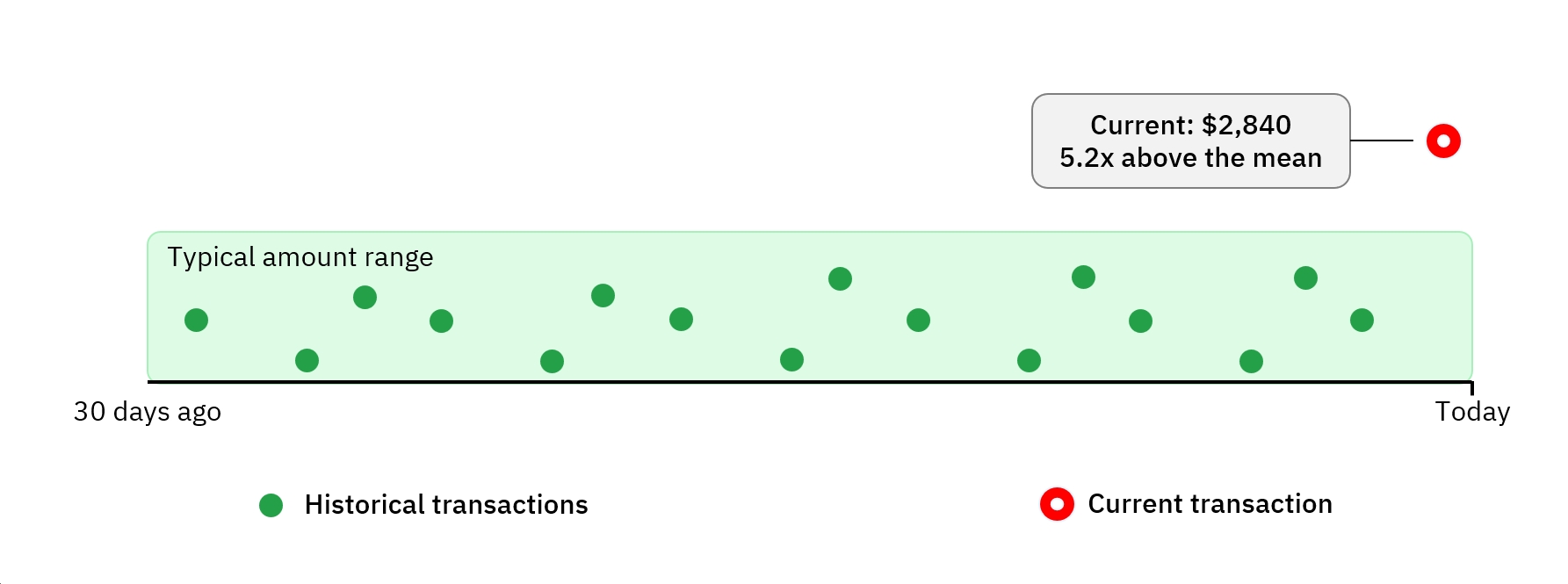
Behavioural Decisioning enriches transactional decisions by incorporating the historical activity patterns of the entities involved in a transaction. Where a deterministic decision evaluates current transaction attributes in isolation, Behavioural Decisioning asks whether the current activity is consistent with the established behavioural profile of the customer, account, or entity involved.
The practical effect is to make thresholds dynamic rather than static. A transaction that appears unremarkable in isolation may be contextually significant against an entity’s behavioural baseline. Conversely, activity that would trigger a static rule may be entirely consistent with an established behavioural pattern. Behavioural Decisioning improves operational precision without changing the fundamental structure of the decision.
| Feature | What it measures | Anomaly signal |
|---|---|---|
| Mean transaction amount | Average amount over past 30 days | Current amount far above historical mean |
| Amount z-score | Std deviations from mean amount | High z-score indicates unusual amount for this entity |
| Transaction frequency | Typical transaction count per week | Activity rate inconsistent with established pattern |
| Merchant category ratio | Proportion of activity by merchant type | Transaction type outside behavioral profile |
| Profile confidence | Days of behavioral history available | Thin history reduces confidence in the baseline |
| Amount percentile | Rank of current amount vs historical distribution | 99th percentile or above signals significant deviation |
Temporal Awareness
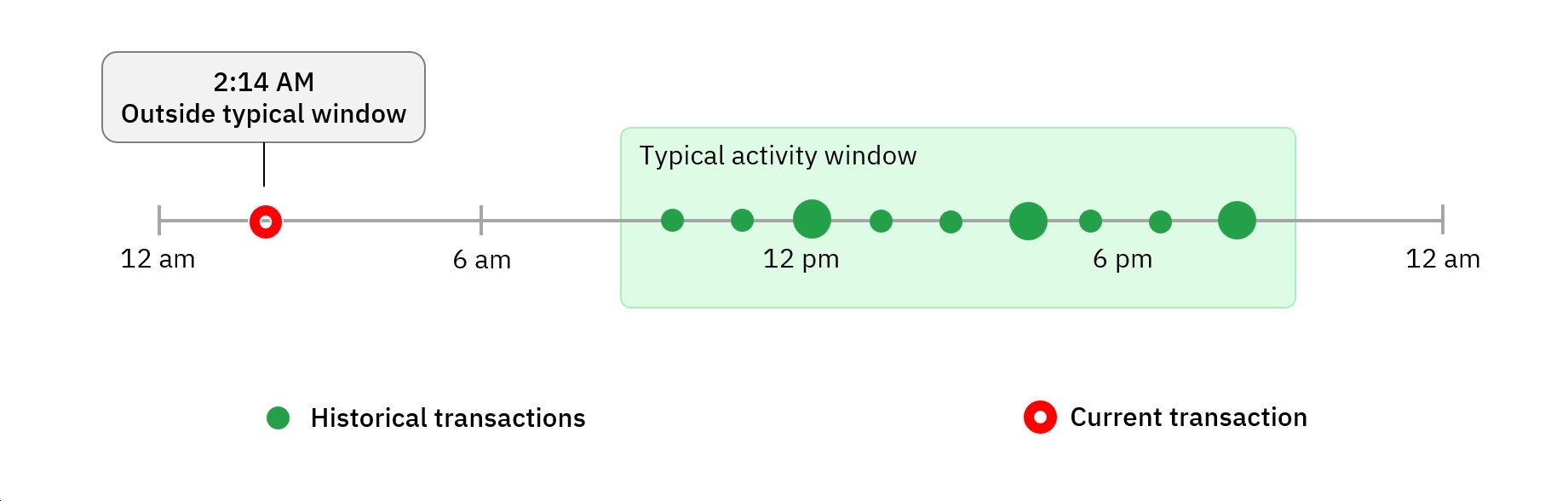
Temporal Awareness enriches decisions by incorporating the timing relationships surrounding a transaction. Time of day, elapsed time since prior activity, and deviation from established temporal patterns are dimensions that static rule-based logic evaluates imprecisely. Temporal Awareness asks whether the timing of current activity is consistent with expected patterns or represents a meaningful deviation.
A transaction occurring at an unusual time relative to an entity’s historical activity profile carries different contextual significance than one occurring within expected temporal boundaries, even when all other attributes are identical. Temporal Awareness allows this distinction to inform the decision, improving sensitivity without requiring explicit rule enumeration for every possible timing scenario.
| Feature | What it measures | Anomaly signal |
|---|---|---|
| Hour of day | Transaction hour (0–23) | Hour falls outside customer’s typical activity range |
| Day of week | Weekday vs weekend (1–7) | Activity on days atypical for this entity |
| Time since last transaction | Elapsed seconds since prior event | Unusual gap or unusually rapid follow-on activity |
| Temporal clustering | Transaction count in rolling window | Multiple transactions in an unusually short period |
| Recency delta | Days since last transaction | Extended inactivity followed by sudden activity |
Velocity-Aware Processing
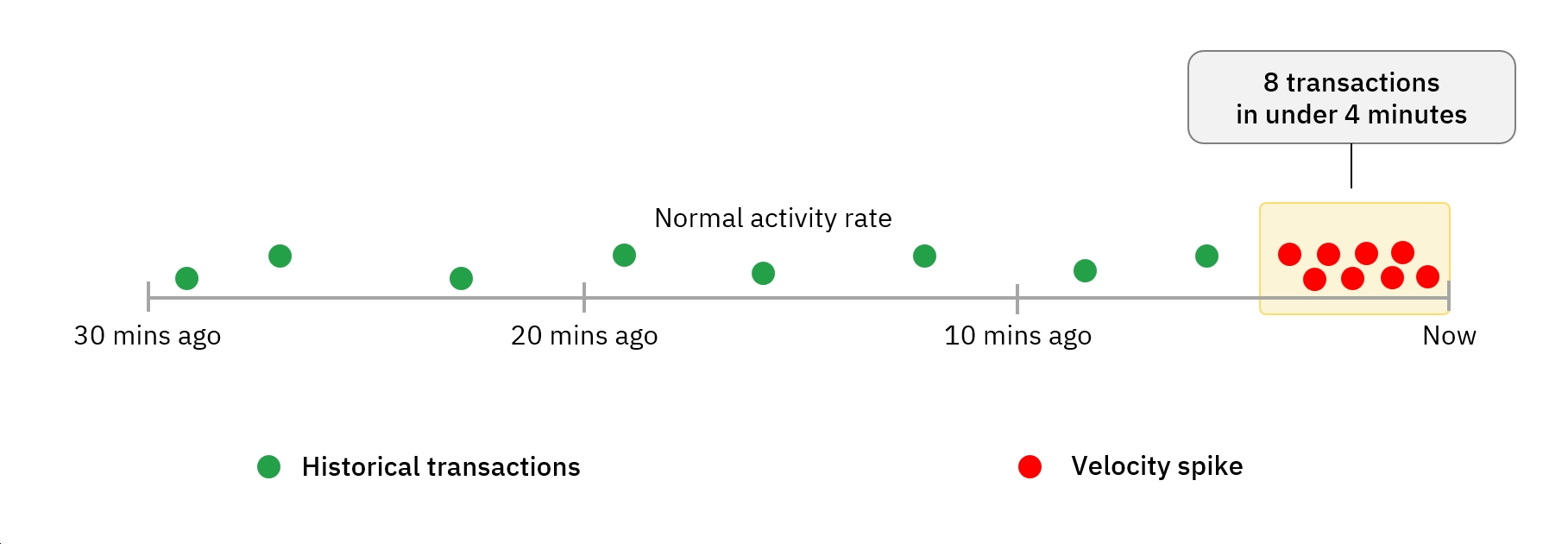
Velocity-Aware Processing enriches decisions by incorporating the intensity and accumulation of activity over time. Where individual transactions may each appear within acceptable bounds, the rate of activity across a short window can represent a materially different operational signal. Velocity-Aware Processing asks whether the pace or volume of current activity indicates accumulation that warrants different handling.
Its value lies in surfacing signals that only become visible at the aggregate level. Decisions that would otherwise evaluate each transaction independently, without awareness of the surrounding activity pattern, gain sensitivity to concentration that individual event attributes do not expose.
| Feature | What it measures | Anomaly signal |
|---|---|---|
| Transactions in 5 minutes | Count in rolling 5-minute window | Count far above historical 5-minute rate |
| Transactions in 1 hour | Count in rolling 60-minute window | Hourly rate significantly above expected baseline |
| Inter-transaction interval | Average seconds between last N transactions | Unusually short intervals between transactions |
| Cumulative amount (1 hour) | Total amount transacted in rolling hour | Hourly accumulation exceeds typical range |
| Velocity ratio | Current rate vs historical mean rate | High ratio signals acceleration above normal baseline |
| Multi-channel velocity | Count of distinct channels used in window | Rapid activity across multiple channels simultaneously |
Sequence-Aware Decisioning
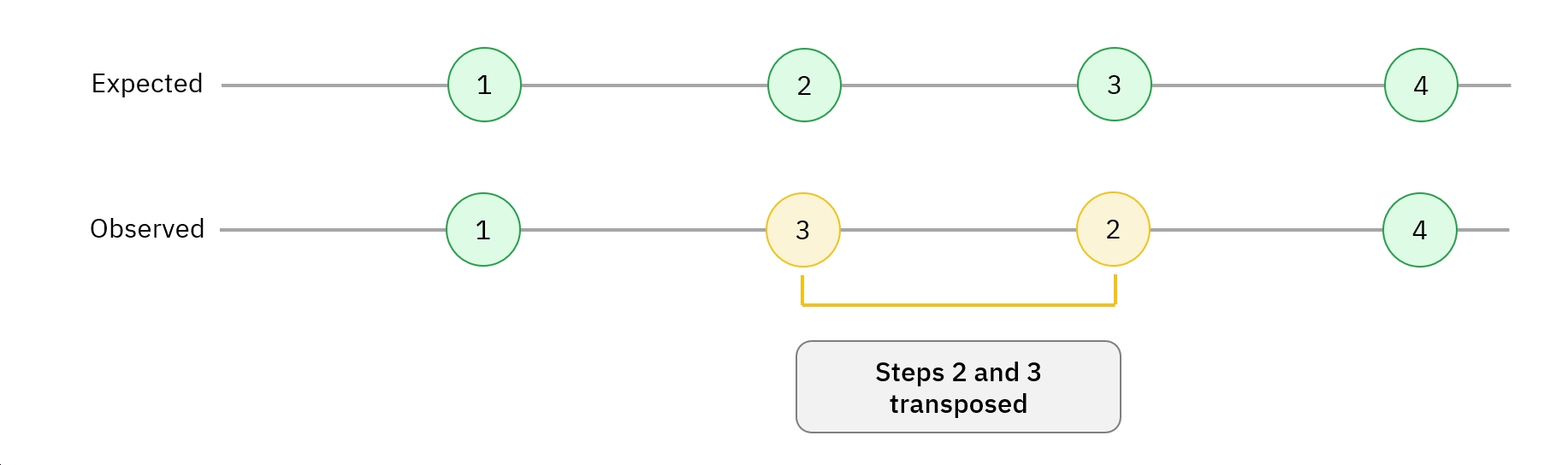
Sequence-Aware Decisioning enriches decisions by incorporating the ordered progression of events leading to the current transaction. Many decisions carry different significance depending on what has preceded them. This pattern asks whether the sequence of events observed is consistent with expected operational progression or indicates something significant that evaluation of the current event alone would not reveal.
Its value lies in distinguishing between transactions that are identical in their immediate attributes but materially different in operational context. An event representing a routine step in a normal sequence carries different significance than the same event following an unusual sequence of prior activity.
| Feature | What it measures | Anomaly signal |
|---|---|---|
| Expected step index | Predicted position in known workflow | Current event occurs at unexpected position |
| Predecessor events present | Count of expected prior events that occurred | Required predecessors absent before current event |
| Step skip count | Expected steps bypassed before current event | Non-zero skip count indicates sequence violation |
| Step order deviation | Difference between expected and observed position | Large deviation indicates out-of-sequence execution |
| Time between steps | Elapsed seconds between sequential events | Unusually short or long interval between expected steps |
| Prerequisite ratio | Expected predecessors present vs expected total | Low ratio indicates incomplete workflow progression |
Network-Aware Processing
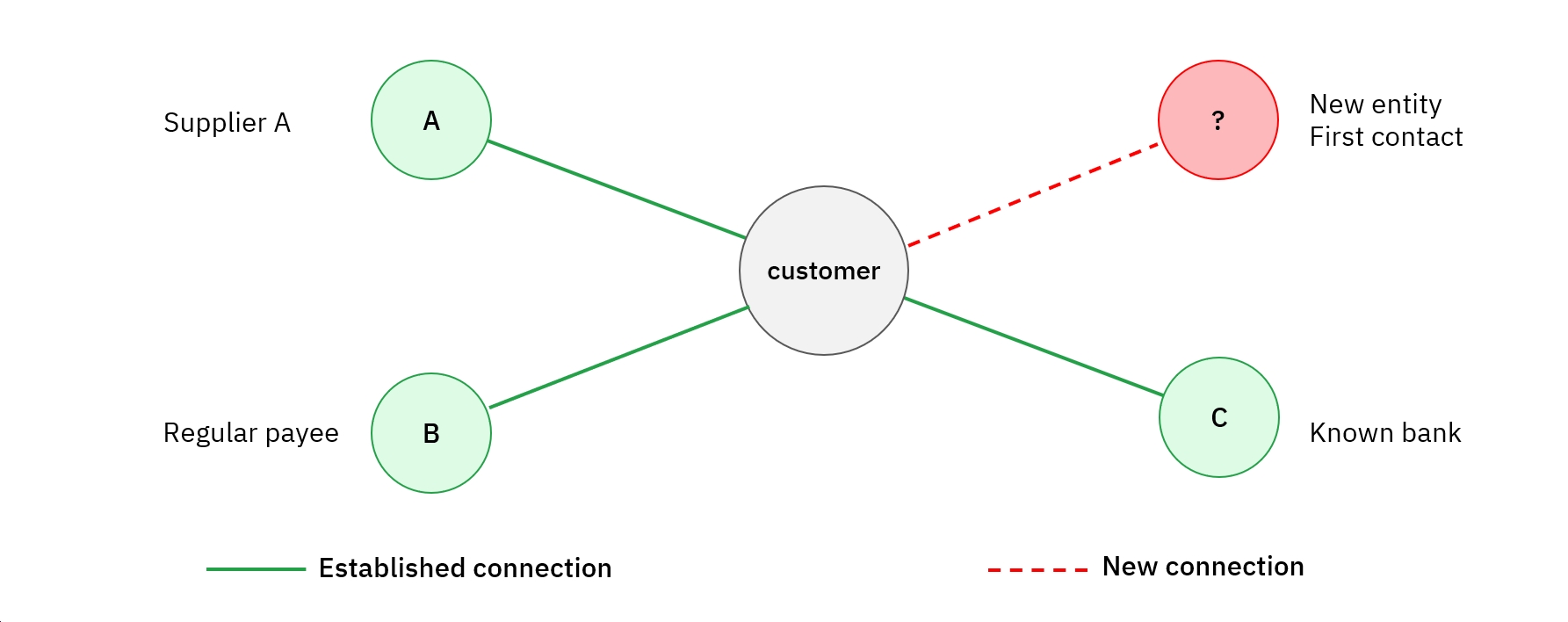
Network-Aware Processing enriches decisions by incorporating the relationships between entities involved in or connected to a transaction. Accounts, customers, counterparties, and operational nodes form relational structures whose properties can materially influence how a transaction should be handled. This pattern asks whether the relationships surrounding the current activity provide contextually relevant information beyond what the immediate transaction attributes contain.
A transaction between entities with an established relationship carries different significance than one involving a previously unconnected counterparty. Network topology can surface operational signals that per-entity or per-transaction evaluation would not otherwise expose.
| Feature | What it measures | Anomaly signal |
|---|---|---|
| Relationship age | Days since first interaction with counterparty | Zero days indicates no prior connection |
| Prior transaction count | Number of prior transactions with this counterparty | Zero count with high-value transaction flags risk |
| Counterparty network degree | Count of entities connected to this counterparty | Isolated or newly appearing entity in network |
| Shared connections | Mutual entities known to both parties | Zero shared connections with a high-value transaction |
| First contact indicator | Boolean: no prior interaction recorded | First contact combined with unusual amount or timing |
| Transaction amount vs relationship age | Amount relative to maturity of relationship | High amount on a new or thin relationship |
State-Aware Processing
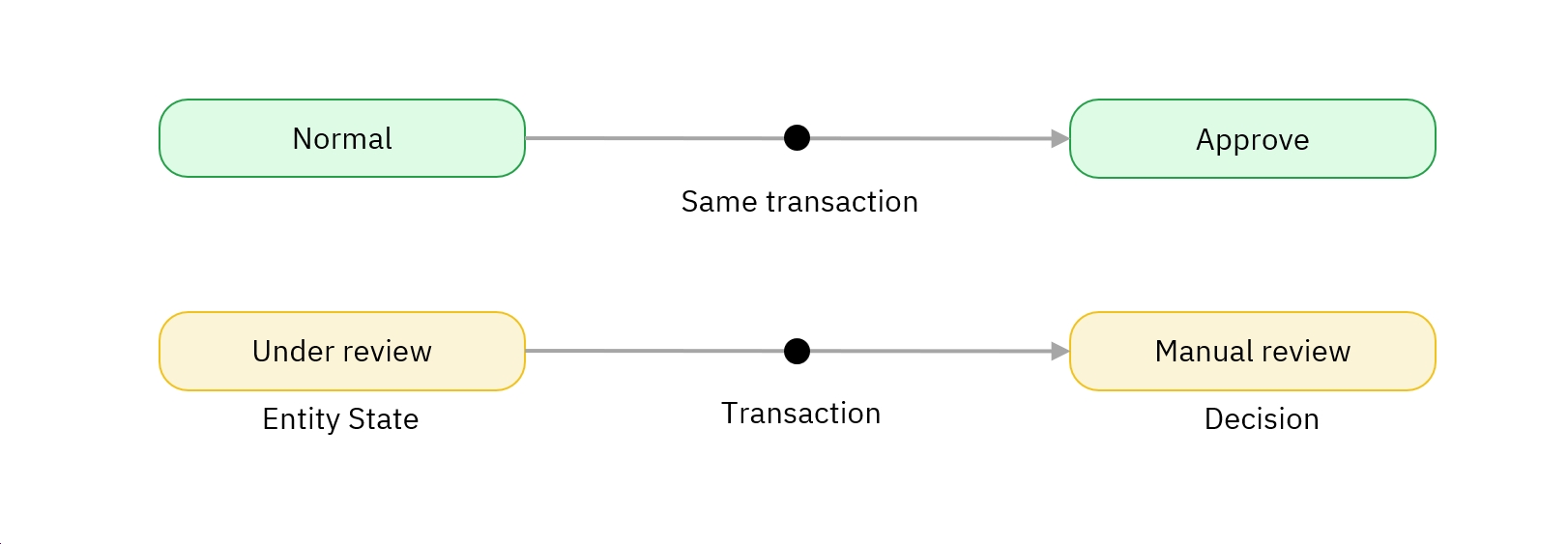
State-Aware Processing enriches decisions by incorporating the current operational or workflow state of the entities and processes involved. Account standing, workflow position, prior intervention outcomes, and process lifecycle stage are dimensions that can materially affect how a decision should be evaluated. This pattern asks whether the current state provides information that changes the appropriate handling of the transaction.
Its value lies in making decisions sensitive to context that persists across individual transactions but is often encoded imprecisely in deterministic rule logic. An entity in an elevated review state warrants different handling than one in a normal operational state, even when immediate transaction attributes are identical.
| Feature | What it measures | Decision influence |
|---|---|---|
| Current entity status | Operational state: normal, review, suspended | Non-normal state modifies decision outcome |
| Days in current state | Elapsed days since last status change | Long duration in elevated state increases concern |
| Status transition count | State changes in past 90 days | Frequent transitions indicate operational instability |
| Prior intervention outcome | Result of most recent manual review | Prior adverse outcome elevates current decision weight |
| Open action flag | Boolean: open review or investigation exists | Active open action requires consideration in routing |
| Workflow position | Stage in broader operational lifecycle | Late-stage position changes applicable decision rules |
Spatial Awareness
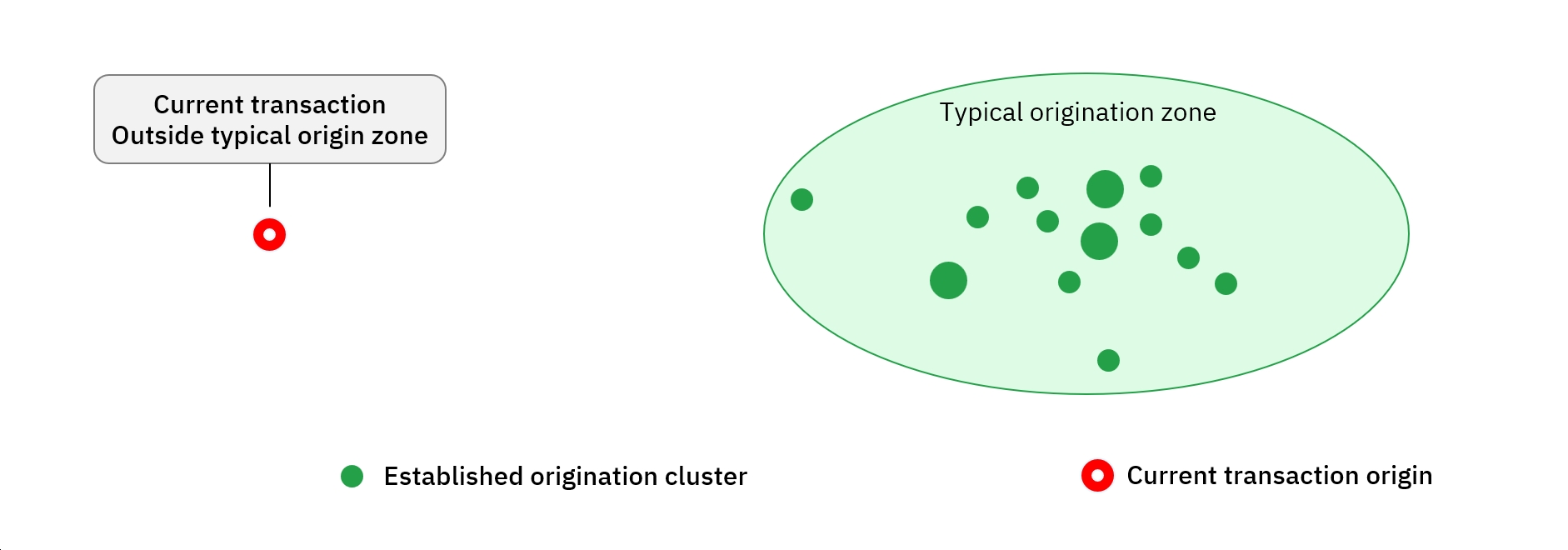
Spatial Awareness enriches decisions by incorporating the execution locality and operational environment surrounding a transaction. Where a transaction originates, the network environment from which it is submitted, and the consistency of that context with established patterns are dimensions that static rules evaluate imprecisely. This pattern asks whether the operational environment represents a contextually meaningful deviation from expected norms.
A transaction originating from an environment consistent with an entity’s established context carries different significance than one originating from an unusual or previously unseen environment. Spatial Awareness allows environmental context to participate in decision evaluation, improving precision without requiring explicit enumeration of every possible execution scenario.
| Feature | What it measures | Anomaly signal |
|---|---|---|
| Distance from registered address | Km from entity’s primary registered location | Large distance inconsistent with prior activity |
| Distance from prior transaction | Km from most recent transaction location | Physically impossible distance given elapsed time |
| Origination country | Country of request or transaction origin | Country not present in prior activity history |
| Device fingerprint match | Known vs previously unseen device | New device combined with unusual location |
| VPN or proxy indicator | Boolean: origin masked by proxy or VPN | Masked origin inconsistent with established pattern |
| Location cluster deviation | Distance from entity’s typical origination centroid | High deviation places origin outside established zone |
Patterns in Practice
The seven patterns are not theoretical constructs. They apply to transactional decisions that already exist within enterprise transaction systems.
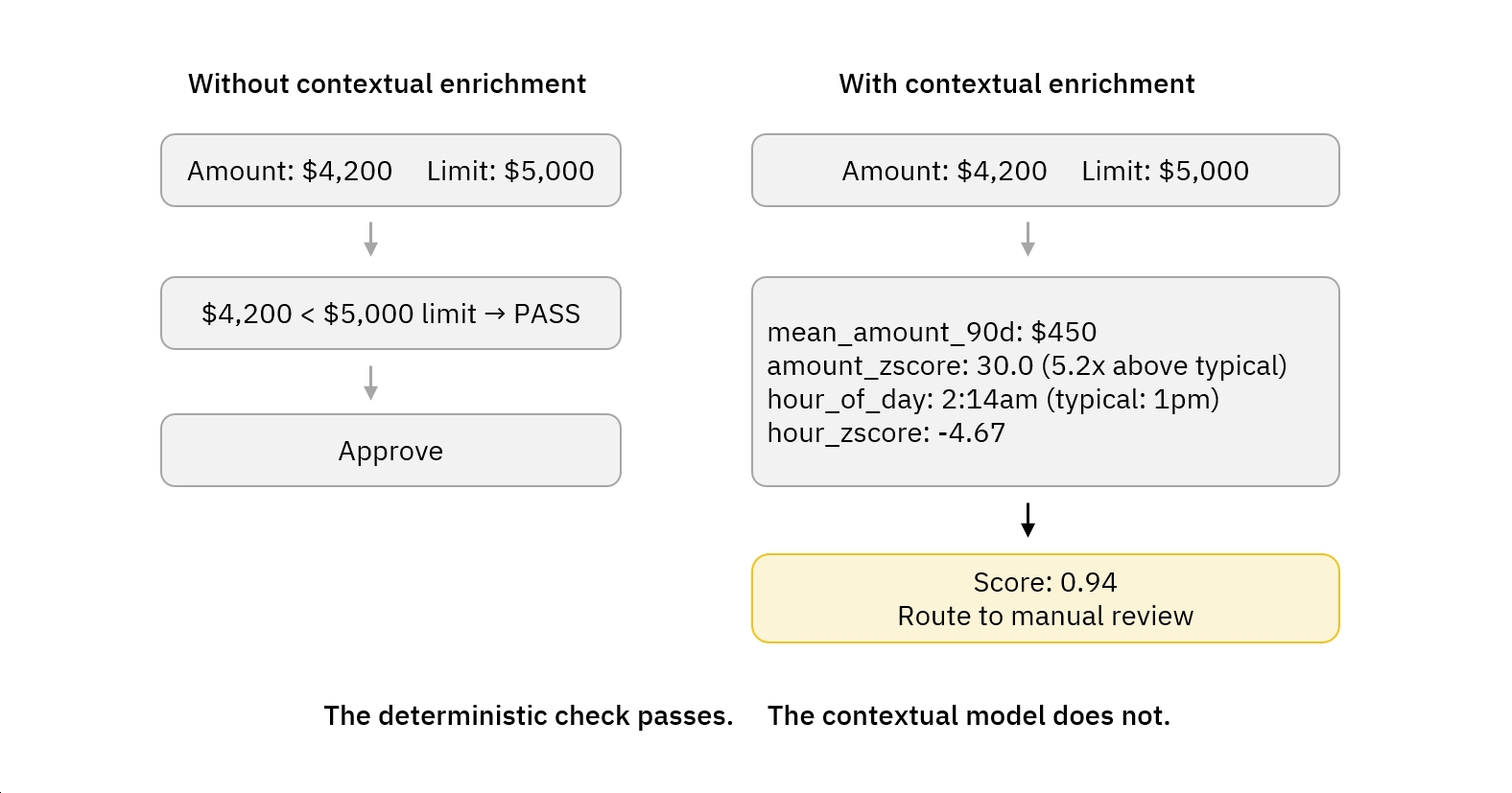
Consider a single authorization decision evaluated two ways: using deterministic logic alone, and using deterministic logic enriched with contextual awareness. The transaction passes the deterministic check in both cases — the credit limit is not breached. By every static rule currently defined, the transaction is approvable. What changes is the quality of information available at the moment of decision. Contextual enrichment does not override the rules. It extends what the rules can see.
Example — Behavioural and Temporal enrichment applied: